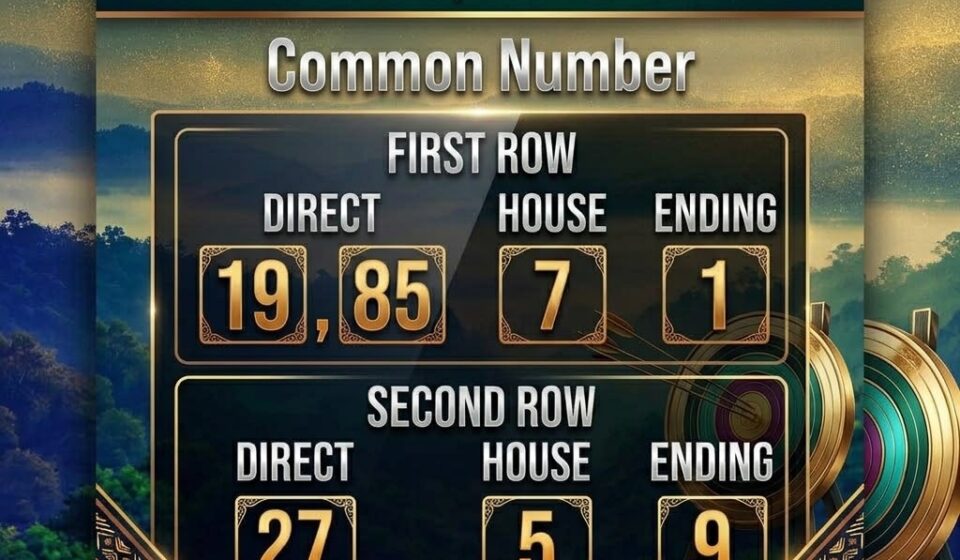

Shillong Morning Teer Common Number: Complete Guide to Common Numbers and Previous Results
Meta Title: Shillong Morning Teer Common Number – Common Number & Result Guide
Meta Description: Learn what Shillong Morning Teer common numbers mean, how players study previous FR and SR results, how common-number charts are prepared, and why past results cannot guarantee future numbers.
Focus Keyword: Shillong Morning Teer Common Number
Secondary Keywords: Shillong Morning Teer, Morning Teer common number, Shillong Teer common number, Shillong Teer FR SR, Shillong Teer previous result, Morning Teer result, Shillong Teer chart, common number today
Introduction
Shillong Morning Teer is an archery-based game associated with Meghalaya and has developed a large following among people who regularly check its First Round (FR) and Second Round (SR) results. Along with the daily result, many players search online for terms such as Shillong Morning Teer Common Number, Morning Teer common number, Shillong Teer previous result, and Shillong Teer chart.
The phrase “common number” generally refers to numbers that appear repeatedly or attract attention when historical results are studied. Some websites calculate their common-number lists from previous results, number frequency, house numbers, ending numbers, or other traditional methods. However, these calculations should be understood as historical analysis rather than a reliable method of predicting the next result. One current data-oriented source specifically notes that each draw should be treated independently and that a number being absent or frequent in the past does not make it “due” in a future draw.
This distinction is important for anyone searching for a Shillong Morning Teer common number. A common number can be useful for organizing and studying previous results, but it should not be described as a guaranteed winning number.
This guide explains the meaning of common numbers, how historical charts are used, what FR and SR mean, how frequency analysis works, and how readers can interpret Morning Teer information responsibly.
What Is Shillong Morning Teer Common Number?
A Shillong Morning Teer common number is generally a number that players identify from previous Morning Teer results because it has appeared more frequently, formed a repeated pattern, or fits a particular traditional calculation.
The term does not have one universally accepted mathematical definition. Different websites and players may use different methods to create their common-number lists.
For example, a common-number analysis may examine:
-
Previous First Round results
-
Previous Second Round results
-
Numbers repeated over a selected period
-
Last digits or ending numbers
-
House numbers
-
Frequency of particular two-digit combinations
-
Recent result sequences
-
Traditional Teer calculations
Some websites publish separate categories such as Direct, House, and Ending numbers. A current Shillong Teer common-number page, for example, publishes these categories while explicitly stating that its figures are based on previous results and do not guarantee winning accuracy.
Therefore, “common number” should be understood as a description of historical patterns, not as an official future result.
Shillong Morning Teer FR and SR Explained
When searching for Morning Teer results, you will frequently see the abbreviations FR and SR.
-
FR means First Round.
-
SR means Second Round.
Historical result archives normally record the two separately. For example, one recent Morning Teer archive lists dates together with individual FR and SR numbers.
Keeping the two rounds separate is important when studying a historical chart. Combining them into one list can produce misleading frequency calculations because the two results belong to different rounds.
A simple historical table might therefore look like this:
| Date | First Round (FR) | Second Round (SR) |
|---|---|---|
| Recent Day 1 | 46 | 68 |
| Recent Day 2 | 58 | 71 |
| Recent Day 3 | 10 | 44 |
| Recent Day 4 | 86 | 90 |
| Recent Day 5 | 34 | 25 |
These figures are examples of how a result archive is structured; they should not be interpreted as future predictions.
A current online archive lists recent Morning Teer records in this FR/SR format, illustrating how historical results can be organized for reference.
How Common Numbers Are Identified
There are several ways players and websites identify common numbers.
1. Frequency Analysis
Frequency analysis is one of the simplest methods.
Suppose a historical data set contains 100 previous results. A person can count how many times each two-digit number appeared.
For example:
| Number | Historical appearances |
|---|---|
| 15 | 7 |
| 57 | 6 |
| 20 | 6 |
| 85 | 5 |
| 70 | 5 |
In this example, 15 appeared more often than the other listed numbers during the selected period.
A published 200-draw analysis similarly presents historical frequency counts, showing that some numbers occurred several times while others appeared less frequently.
However, frequency should not be confused with probability of the next result. If a number appeared frequently in the past, that does not establish that it is more likely to appear next.
2. House Number Analysis
Another popular approach is the house number.
A two-digit number can be grouped according to its tens digit. For example:
-
10–19 → House 1
-
20–29 → House 2
-
30–39 → House 3
-
40–49 → House 4
-
50–59 → House 5
-
60–69 → House 6
-
70–79 → House 7
-
80–89 → House 8
-
90–99 → House 9
Different Teer communities may use terminology or calculation methods somewhat differently, so readers should check how a particular chart defines “house.”
House analysis is mainly useful for organizing historical numbers. It can tell you which groups have appeared more frequently in a selected historical sample.
3. Ending Number Analysis
An ending number refers to the final digit of a two-digit result.
For example:
-
21 ends in 1
-
36 ends in 6
-
48 ends in 8
-
75 ends in 5
-
90 ends in 0
A historical chart can count how often each ending digit appeared.
This can make a large list of results easier to analyze. Instead of examining every two-digit number individually, a reader can first examine the distribution of final digits.
Again, this is descriptive analysis. It does not establish which ending will occur in a future round.
Why Players Search for Shillong Morning Teer Common Number
The popularity of common-number searches comes largely from the desire to find structure in a long sequence of historical results.
A daily result may look like a simple two-digit number, but over several weeks or months a chart can contain hundreds of entries. Players may therefore look for:
-
Repeated numbers
-
Frequently appearing endings
-
Numbers that have recently appeared
-
Numbers that have not appeared for a while
-
Similar patterns between different dates
-
FR and SR frequency differences
Historical archives make this type of research easier because they organize old results by date and round. Several online archives provide date-wise FR and SR records specifically for this purpose.
Shillong Morning Teer Previous Result and Common Number Analysis
The previous result is one of the most frequently used sources for common-number analysis.
For example, a reader might collect the previous 30, 50, 100, or 200 results and count the frequency of every number.
A basic process looks like this:
-
Collect historical FR results.
-
Keep SR results in a separate data set.
-
Count how many times each number appears.
-
Calculate ending-digit frequencies.
-
Group numbers by house.
-
Compare short-term and longer-term frequencies.
-
Record the results without treating them as guaranteed predictions.
This approach is more transparent than simply publishing a list of numbers without explaining where they came from.
For example, if a website says that a particular number is “common,” readers should ideally be able to determine:
-
Which dates were analyzed?
-
How many results were included?
-
Was FR analyzed separately from SR?
-
Was the calculation based on frequency?
-
Were ending digits included?
-
Was a traditional formula used?
-
Is the result being presented as historical information or as a prediction?
These questions help readers distinguish data analysis from promotional claims.
Can a Common Number Guarantee the Next Shillong Morning Teer Result?
No.
A historical common number cannot guarantee a future Shillong Morning Teer result.
This is one of the most important points when reading any Morning Teer common-number article. A number may have appeared several times in historical records and still fail to appear in the next round. Likewise, a number that has not appeared recently can appear in a subsequent result.
A current historical-analysis source explicitly emphasizes that past results do not determine future results and that there is no mathematical reason to treat an absent number as “due.”
Some common-number websites also include disclaimers stating that their lists are based on previous results, repeated numbers, last-digit frequency, and other calculations and that there is no guarantee of winning.
Consequently, phrases such as “100% sure common number,” “guaranteed hit,” or “fixed winning number” should be treated cautiously.
Shillong Morning Teer Common Number Today
Searches for “Shillong Morning Teer common number today” are usually looking for a current daily list.
Daily common-number pages may publish a combination of:
-
Direct numbers
-
House numbers
-
Ending numbers
-
FR references
-
SR references
-
Previous-result statistics
Because these pages can change every day, it is important to check the publication date before using the information.
For example, one current common-number page published a daily list for September 18, 2026 and separated direct, house, and ending categories. It also stated that the numbers were derived from historical analysis rather than being guaranteed outcomes.
Readers should therefore distinguish between:
Today’s historical analysis
and
Today’s official result.
They are not the same thing.
The official result is the actual declared outcome. A common-number list is an analysis or prediction published before the result.
Shillong Teer Chart and Historical Data
A Shillong Teer chart is essentially a record of historical results.
A useful chart generally includes:
| Date | FR | SR |
|---|---|---|
| Day 1 | 01 | 93 |
| Day 2 | 25 | 44 |
| Day 3 | 80 | 49 |
| Day 4 | 14 | 72 |
| Day 5 | 03 | 36 |
The value of a chart is that it lets readers inspect historical data rather than relying entirely on memory.
Several current result archives provide date-wise historical FR and SR records.
When studying a chart, readers should pay attention to the date and the round. Leading zeroes are also important: 03 and 30 are different two-digit numbers.
How to Study a Shillong Morning Teer Result Chart
A simple historical-analysis method can be divided into several stages.
Step 1: Choose a Time Period
Decide whether you want to analyze:
-
The previous 7 results
-
The previous 15 results
-
The previous 30 results
-
The previous 100 results
-
A longer historical period
Different sample sizes can produce very different frequency counts.
Step 2: Separate FR and SR
Do not automatically combine First Round and Second Round results.
Create two columns:
FR: First Round
SR: Second Round
This makes the analysis easier to understand.
Step 3: Count Repeated Numbers
Count how many times each number appeared in the selected period.
A simple frequency table could look like:
| Number | Frequency |
|---|---|
| 15 | 4 |
| 27 | 3 |
| 46 | 3 |
| 58 | 2 |
| 71 | 2 |
The table describes the historical sample. It does not forecast the next result.
Step 4: Study the Last Digit
Count the final digits separately.
For example:
| Ending | Frequency |
|---|---|
| 0 | 8 |
| 1 | 11 |
| 2 | 9 |
| 3 | 10 |
| 4 | 7 |
This may reveal which endings occurred most often in the selected sample.
Step 5: Compare Different Periods
A number that appears frequently over 100 results might not have appeared recently.
Conversely, a number that appears twice in the last 10 results might have appeared rarely over a much longer period.
That is why it is useful to specify the time period whenever publishing a common-number analysis.
Common Number vs. Previous Result vs. Official Result
These terms are sometimes mixed together, but they have different meanings.
Common Number
A number identified through historical frequency or another traditional analysis method.
Previous Result
A number that has already been officially recorded for a previous round.
Official Result
The actual result declared for the relevant round.
Prediction
A number suggested before the result is known.
A good Shillong Morning Teer article should clearly distinguish all four.
This prevents readers from confusing an analytical list with an official result.
Why Previous Results Can Be Useful for Research
Historical results can be useful even when they cannot predict the future.
For example, a researcher can use them to:
-
Build a frequency table
-
Study the distribution of numbers
-
Compare FR and SR
-
Examine ending digits
-
Study how often particular numbers have appeared
-
Identify repeated historical sequences
-
Create charts and visualizations
-
Check whether a published claim matches historical data
A historical database therefore has value as a record even without making predictions.
One published archive describes its previous-result database as a way to review First Round and Second Round winning numbers over historical dates.
Common Mistakes When Reading Teer Common Numbers
Mistake 1: Assuming “Hot” Means “Due”
A frequently appearing number is sometimes described as “hot.” That is a description of its historical frequency.
It does not mean the number must appear again.
Mistake 2: Assuming an Absent Number Must Appear
A number that has not appeared for several rounds is sometimes called “due.”
That is not a mathematical guarantee.
Mistake 3: Mixing Different Data Sets
Combining Morning Teer, regular Shillong Teer, Khanapara Teer, or other games without clearly labeling them can make frequency analysis misleading.
Mistake 4: Ignoring the Date
Daily common-number pages can change. A list published yesterday should not automatically be described as today’s analysis.
Mistake 5: Treating a Prediction as a Result
A common-number list published before a round is not the same as the official result after the round.
Responsible Approach to Shillong Morning Teer
Because Teer involves wagering, readers should approach common-number information carefully.
A sensible approach is to treat online number charts as informational or historical material, not as a source of guaranteed income.
Do not assume that:
-
A mathematical-looking formula guarantees success.
-
A frequently repeated number must repeat.
-
A “100%” claim is actually certain.
-
Paying someone guarantees a winning number.
-
Past results can determine a future result.
One Shillong Teer information page specifically warns readers that there is no “making number” and advises against paying anyone for a Teer number.
Readers should also follow the applicable laws and regulations where they live and avoid spending money they cannot afford to lose.
Frequently Asked Questions
What is Shillong Morning Teer common number?
Shillong Morning Teer common number generally refers to numbers identified from historical Morning Teer results because they have appeared repeatedly or fit a particular traditional calculation. It is not an official guarantee of a future result.
What does FR mean in Shillong Morning Teer?
FR means First Round. Historical Morning Teer archives commonly record FR separately from SR.
What does SR mean?
SR means Second Round. It is recorded separately from the First Round in result charts.
How are common numbers calculated?
There is no single universal formula. Different sources may use previous results, frequency, ending digits, house numbers, repeated numbers, or traditional calculation methods.
Can previous results predict the next number?
Previous results can be analyzed statistically, but they do not guarantee the next result. Historical frequency is descriptive rather than proof of future probability.
What is a Shillong Teer chart?
A Shillong Teer chart is a historical record of results, usually arranged by date and showing First Round and Second Round numbers.
What is an ending number?
An ending number is the final digit of a two-digit result. For example, 47 has an ending of 7.
What is a house number?
In common Teer terminology, house numbers group two-digit numbers according to their tens digit. Different websites can use slightly different terminology, so the definition should be checked before comparing charts.
Is a common number the same as an official result?
No. A common number is an analytical or predictive reference. An official result is the actual number declared after the relevant round.
Where can I check previous Shillong Morning Teer results?
Historical result archives are available online and typically provide date-wise FR and SR records. Because different websites can display different games or schedules, readers should verify the date, round, and source before relying on a record.
Are “100% sure” Teer numbers guaranteed?
No. A claim of guaranteed accuracy should not be treated as a mathematical fact. Common-number pages themselves may state that their figures are based on historical calculations and do not guarantee winning.
Final Thoughts on Shillong Morning Teer Common Number
The Shillong Morning Teer Common Number is best understood as a way of discussing historical patterns in Morning Teer results. Players and researchers may examine previous FR and SR results, frequency, house numbers, ending digits, and repeated combinations when building a common-number chart.
However, historical patterns should remain clearly separated from official results. A number that appeared several times previously is not guaranteed to appear again, while a number that has been absent for a period is not automatically due.
For anyone researching Shillong Morning Teer, the most useful practice is to record the date, FR, SR, sample size, and calculation method whenever examining common numbers. This makes the analysis easier to verify and reduces confusion between historical information and predictions.
Ultimately, a common-number chart can organize past data and show what happened previously. It cannot turn historical results into a guaranteed forecast of what will happen