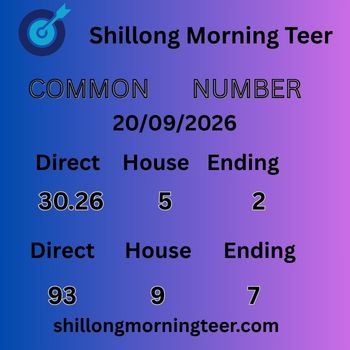

Shillong Morning Teer Common Number – Daily Guide
Shillong Morning Teer Common Number is a frequently searched topic among people who follow Shillong Teer results, previous-result charts, and number-based analysis. Many readers check historical results before the morning session and look for common, repeated, house, ending, and direct numbers.
A common number should be understood as a historical or analytical reference, not as a guaranteed result. Previous results can be studied to identify numbers and digits that have appeared repeatedly, but they cannot determine with certainty what the next round will produce.
This article explains what Shillong Morning Teer common numbers mean, how historical results can be analyzed, and what readers should consider when looking at daily number predictions.
What Is Shillong Morning Teer?
Shillong Teer is a traditional archery-based game associated with Meghalaya. The result is connected with the number of arrows that hit a target during the relevant round. The final result is represented by the last two digits of the total arrow count.
The Morning Teer session is generally discussed in two separate rounds:
-
F/R – First Round
-
S/R – Second Round
Because these are separate rounds, the F/R and S/R results should be recorded and analyzed separately.
People following the game commonly search for previous results, common numbers, house numbers, ending numbers, target numbers, and other forms of number analysis.
The published schedule and results can change or be updated, so readers should verify the current information from an authoritative source before relying on a particular time or result.
What Is a Shillong Morning Teer Common Number?
The phrase common number generally refers to a number that has appeared repeatedly in a selected set of previous results.
For example, imagine that a historical chart contains the following results:
12, 28, 45, 12, 63, 28, 71, 12
In this simple example, 12 and 28 appear more than once. Someone analyzing this small sample might describe them as common numbers.
However, this does not mean that the same numbers must appear again. The word “common” describes what has been observed in historical data; it does not create a guarantee for a future result.
Different websites may also use the term in different ways. One page may calculate common numbers from seven days of results, while another may use 15, 30, or more days.
Therefore, it is always useful to check the method behind a common-number list rather than looking only at the final numbers.
How Previous Results Are Used
Previous results are the main source of information for most common-number analysis.
A reader can collect the results for a specific period and arrange them by date. The results can then be separated into F/R and S/R.
For example:
| Day | F/R | S/R |
|---|---|---|
| Day 1 | 24 | 61 |
| Day 2 | 37 | 80 |
| Day 3 | 24 | 45 |
| Day 4 | 52 | 71 |
| Day 5 | 68 | 24 |
In this example, 24 occurs several times. It could therefore be described as a repeated or common number within this small data set.
The same process can be applied to a larger historical period. A larger sample generally provides more information than a very short chart, although even a large historical sample cannot guarantee a future result.
Understanding House and Ending Numbers
Shillong Teer number analysis often uses the terms House and Ending.
For a two-digit result such as 47:
-
4 is the House digit.
-
7 is the Ending digit.
-
47 is the complete Direct Number.
For a result such as 82:
-
House = 8
-
Ending = 2
-
Direct = 82
This separation allows people to study historical results at different levels.
For example, perhaps the exact number 47 does not occur frequently, but the Ending digit 7 may appear several times. That creates a different type of historical observation.
Similarly, a House digit might appear frequently even when individual two-digit numbers beginning with that digit do not repeat often.
What Is a Direct Number?
A Direct Number is the complete two-digit result.
If the result is 36, the Direct Number is 36.
Historical Direct Number analysis involves counting how frequently particular two-digit numbers occur in a selected period.
For example:
-
15 appeared 2 times
-
27 appeared 1 time
-
42 appeared 3 times
-
68 appeared 2 times
In this hypothetical example, 42 has the highest frequency within the selected sample.
But frequency should not be confused with certainty. A number appearing three times previously does not mean that it is mathematically required to appear again.
Common Number and Target Number
The terms Common Number and Target Number are often found together on Teer-related websites, but they can have different meanings depending on the publisher.
A common number usually describes a number identified through repeated historical appearances or a particular calculation.
A target number generally refers to a number that an analyst highlights as a possible number for a particular round.
These are prediction terms rather than official result categories.
The actual result is determined by the relevant round and should be checked after the result is officially declared.
How to Analyze Shillong Morning Teer Common Numbers
A simple historical analysis can be performed in several steps.
Step 1: Collect Previous Results
Start with a reliable historical-result chart. Record the date, F/R and S/R separately.
Avoid drawing strong conclusions from only a few results.
Step 2: Count Direct Numbers
Count how many times each two-digit number appears during the selected period.
This can reveal repeated numbers within the sample.
Step 3: Analyze House Digits
Take the first digit of each result and count its frequency.
For example, results such as 12, 18, 24, 27 and 31 produce House digits 1, 1, 2, 2 and 3.
Step 4: Analyze Ending Digits
Repeat the process using the final digit.
For 12, 18, 24, 27 and 31, the Ending digits are 2, 8, 4, 7 and 1.
Step 5: Compare Different Time Periods
A useful analysis can compare different periods, such as:
-
Previous 7 results
-
Previous 15 results
-
Previous 30 results
A pattern appearing only in a very short period may not remain visible when the data set becomes larger.
Why Historical Patterns Are Not Guarantees
One of the most important points about common-number analysis is that past frequency does not guarantee future frequency.
Suppose a particular number appears several times in a historical chart. It is tempting to assume that the number has become “strong” and must appear again.
That assumption is not justified simply from the historical record.
Likewise, if a number has not appeared for many rounds, it should not automatically be considered “due.”
Historical data can describe what happened. It cannot by itself establish what must happen next.
This is why terms such as “100% fixed,” “guaranteed number,” or “sure-shot number” should be treated with caution.
Shillong Morning Teer Common Number Today
People often search specifically for “Shillong Morning Teer common number today.” A daily article may summarize recent results and explain which numbers or digits have appeared frequently in the available historical data.
However, a daily common-number list should not be presented as an official result.
A useful daily post can instead explain:
-
Recent F/R results
-
Recent S/R results
-
Frequently appearing Direct Numbers
-
Frequently appearing House digits
-
Frequently appearing Ending digits
-
Changes compared with an earlier period
This provides readers with context rather than presenting an uncertain prediction as a fact.
Importance of Checking the Final Result
Prediction pages and historical charts should always be separated from the final result.
Before accepting a result, readers should verify it through an authoritative source. Websites and social-media pages can sometimes publish outdated, copied, or incorrect information.
The official Shillong Teer website identifies itself as an official source for Shillong Teer results. Readers should use authoritative information when checking the final declared result.
Frequently Asked Questions
What is Shillong Morning Teer Common Number?
It generally means a number that appears repeatedly in a selected group of previous Morning Teer results or is identified through a particular historical calculation.
Is a common number guaranteed?
No. A common number is a historical or prediction-based reference and cannot guarantee a future result.
What is F/R in Morning Teer?
F/R generally means the First Round.
What is S/R in Morning Teer?
S/R generally means the Second Round.
What is a House Number?
The House digit is generally the first digit of a two-digit result.
What is an Ending Number?
The Ending digit is generally the final digit of a two-digit result.
What is a Direct Number?
The Direct Number is the complete two-digit result, such as 24, 57 or 81.
Can previous results predict the next result?
Previous results can be analyzed for historical patterns, but they cannot guarantee the next result.
Final Thoughts
Shillong Morning Teer Common Number remains a popular search phrase because many followers are interested in studying previous results and identifying repeated numbers and digits.
The most useful way to understand common numbers is to treat them as part of a historical analysis. F/R and S/R should be examined separately, while Direct, House and Ending numbers can be counted to identify different types of patterns.
At the same time, historical repetition should never be treated as certainty. A number that appeared frequently yesterday or during the previous few rounds is not guaranteed to appear again, and a number that has been absent for some time is not automatically due.
For readers following Shillong Morning Teer, the best practice is to use historical charts for information, distinguish predictions from official results, verify the final result through an authoritative source, and avoid claims that promise guaranteed or fixed numbers.
If participating in Teer or any other betting activity, follow applicable local laws and set limits so that entertainment does not become a financial burden.