
# Bhutan Teer Common Number: Result Center, Previous Results, F/R, S/R and Complete Guide
The **Bhutan Teer Common Number** is a popular topic among people who regularly follow Teer results and historical number charts. Along with the latest result, many visitors search for previous results, First Round, Second Round, House, Ending and common-number information before checking the day’s update.
A good **Bhutan Teer Result Center** should make this information simple to understand. Readers should be able to identify the correct date, check the First Round and Second Round, review previous results and understand what different number terms mean.
For newcomers, the terminology can sometimes be confusing. A two-digit result may be discussed as a Direct number, while its first digit may be called the House and its last digit the Ending. Meanwhile, terms such as “common number” or “strong number” are often used on result-related websites to describe numbers selected from previous-result analysis.
It is important to understand that these terms describe ways of organising or discussing numbers. They do not provide a guaranteed method of predicting a future result.
## What Is Bhutan Teer?
Bhutan Teer is associated with an archery-based result system in which the number of arrows recorded during a round is used to produce a two-digit result. The final result is commonly displayed using the last two digits of the counted total.
For example, if a hypothetical arrow count were 356, the displayed two-digit result could be **56**. If the total were 402, the result could be **02**.
This format is one reason historical result charts are so popular. Readers can collect the results from different dates and compare them in a simple two-digit format.
Unlike ordinary number lists, Teer discussions are connected with the archery event that produces the underlying count. This is also why checking the declared result is more important than relying solely on predictions or online speculation.
## What Is a Bhutan Teer Result Center?
A **Bhutan Teer Result Center** is an online information page or website where people can check Teer-related results and historical records.
A well-organised result center may contain several sections, including:
* Bhutan Teer Result Today
* First Round result
* Second Round result
* Previous result chart
* Common numbers
* House and Ending
* Historical result records
* Result timings
* Frequently asked questions
The main advantage of a result center is convenience. Instead of searching through many separate posts, readers can find current and previous information in one place.
For regular followers, the previous-result section can be particularly useful because it provides a chronological record. A reader can look back at earlier dates and compare the results without having to remember individual numbers.
However, an online result center should not automatically be considered the official authority. When an important result is involved, readers should verify it through the appropriate authorised source.
## What Is the Bhutan Teer Common Number?
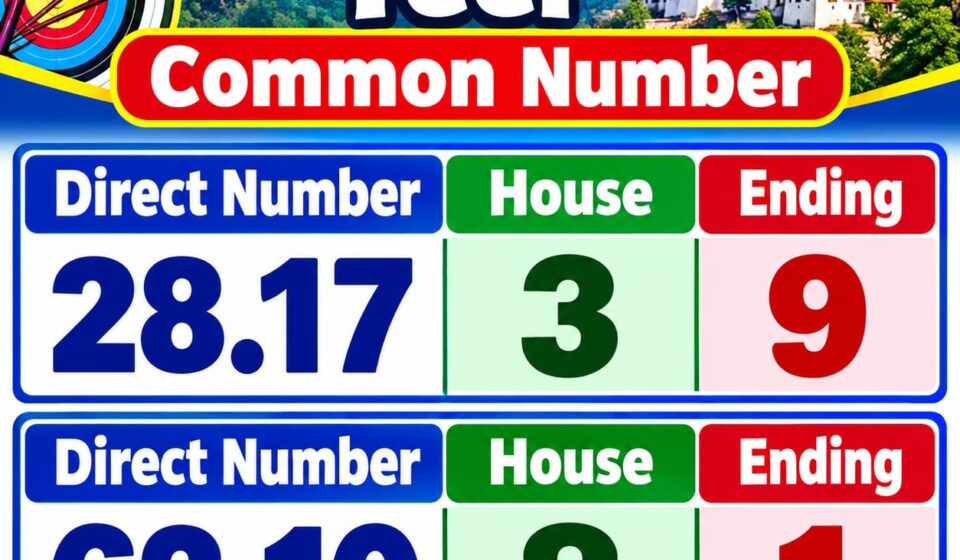
The phrase **Bhutan Teer Common Number** generally refers to numbers that are highlighted because of observations made from previous results.
Different people may use different methods when creating a common-number list. Some examine recent results, while others study longer historical charts.
Common-number discussions may consider:
* Frequently appearing digits
* Repeated two-digit numbers
* House numbers
* Ending numbers
* Recent result sequences
* Older historical patterns
* Numbers that appear more than once in a chart
For example, suppose a historical chart contains the following results:
**24, 51, 68, 24, 73, 41, 68**
Someone studying the chart may notice that 24 and 68 have appeared more than once. They might describe these as noticeable or common numbers in that particular historical sample.
That does not mean either number is guaranteed to appear again.
This distinction is extremely important. A historical frequency is an observation about the past. It is not proof of what the next result will be.
## Why Do People Search for Common Numbers?
People are naturally interested in patterns. When a chart contains dozens or hundreds of numbers, repeated digits and combinations are easy to notice.
A common-number list can make a large historical chart easier to discuss. Instead of looking at every result, a reader can focus on a smaller group of numbers that has attracted attention.
For some readers, this is simply a way to organise information. Others use it as part of their personal number analysis.
The important point is to keep expectations realistic. A number appearing several times in previous results does not create a guarantee that it will appear in a future result.
Similarly, a number that has not appeared recently does not become automatically more likely simply because it has been absent.
## Understanding F/R and S/R
Two terms appear frequently on Bhutan Teer result pages:
**F/R – First Round**
**S/R – Second Round**
The First Round is the first result recorded for the relevant session, while the Second Round represents the following result.
A simple result table may look like this:
| Date | F/R | S/R |
| ——— | –: | –: |
| Example 1 | 27 | 64 |
| Example 2 | 43 | 18 |
| Example 3 | 71 | 52 |
In this example, 27 is the First Round result for Example 1 and 64 is the Second Round result.
When checking a real result, the date is just as important as the number. A result from an earlier date should never be mistaken for the current day’s result.
## What Is a Previous Result Chart?
The **Bhutan Teer Previous Result Chart** is a record of results from earlier dates.
A typical chart contains:
**Date | First Round | Second Round**
Historical charts are valuable because they allow readers to examine information in chronological order.
For example:
| Date | First Round | Second Round |
| ——— | ———-: | ———–: |
| Monday | 16 | 72 |
| Tuesday | 48 | 35 |
| Wednesday | 29 | 81 |
| Thursday | 63 | 14 |
These numbers are only an example of chart formatting and should not be interpreted as actual predictions or current results.
A real historical chart can contain a much larger number of entries, making it easier to see repeated digits, different combinations and changes across time.
## How to Read a Bhutan Teer Result
Reading a result is straightforward once the terminology is understood.
First, identify the **date**.
Next, determine which session or result you are checking.
Then look at the **F/R** column for the First Round.
After that, check the **S/R** column for the Second Round.
For example:
**Date:** Example Date
**F/R:** 38
**S/R:** 75
Here, 38 is the First Round and 75 is the Second Round.
If the website also provides House and Ending information, the two-digit numbers can be broken down further.
## House and Ending Explained
Suppose the result is:
**58**
The first digit, **5**, is commonly referred to as the House.
The final digit, **8**, is the Ending.
Therefore:
**58 = House 5 + Ending 8**
This method is frequently used when people analyse previous results.
For example, a person might make a historical table showing the frequency of different House digits. Another might focus on Ending digits.
This can make a large amount of historical information easier to organise.
However, House and Ending analysis has the same limitation as common-number analysis: it describes previous results but cannot guarantee a future result.
## Direct Number Meaning
A **Direct number** usually refers to the complete two-digit result.
For example:
**42**
Here:
* Direct = 42
* House = 4
* Ending = 2
Breaking the number into these parts is useful for understanding Teer terminology and reading result charts.
A result center may display all three types of information so that visitors can quickly understand the number from different perspectives.
## How to Check Bhutan Teer Result Center Information
When visiting a Bhutan Teer Result Center, readers should follow a simple process.
### 1. Check the Date
Always confirm that the result belongs to the date you are interested in.
### 2. Identify the Round
Make sure you know whether the number belongs to F/R or S/R.
### 3. Check the Result
Read the two-digit number carefully.
### 4. Compare With Previous Results
If you want to study historical information, move to the previous-result chart and compare earlier dates.
### 5. Verify Important Information
When accuracy matters, confirm the declared result with the relevant authorised source.
This process reduces the chance of confusing an old result with a new one.
## Why Result Verification Is Important
Online result websites can be convenient, but information should always be checked carefully.
A website might update its page later than another source, display an older result at the top of a page, or use a different layout for the same information.
For this reason, readers should look at the date and round rather than simply copying the first number they see.
A responsible result center should clearly identify whether a number is a **declared result**, a **previous result**, or an **analysis-based common number**.
These are three different things.
A declared result is an outcome that has already been announced.
A previous result is a historical outcome.
A common number is generally a number selected or highlighted through analysis.
Keeping these categories separate makes the information much easier to understand.
## Can Common Numbers Predict the Next Result?
This is one of the most important questions surrounding Bhutan Teer.
Historical data can show what happened previously, but it cannot guarantee what will happen next.
Suppose a particular number appears three times in an old chart. That tells us that the number appeared three times in that historical period. It does not prove that the same number will appear tomorrow.
Likewise, suppose a particular ending digit has not appeared for several days. Its absence does not create a mathematical obligation for that digit to appear next.
Patterns can be interesting to study, but they should not be presented as certainty.
Anyone claiming to have a guaranteed Bhutan Teer number should be treated cautiously.
## Responsible Approach to Teer Information
Because Teer can involve financial participation, readers should approach result and prediction content responsibly.
A common number should never be described as guaranteed. Previous results should not be presented as proof of a future outcome. Charts are useful for historical reference, but they cannot eliminate uncertainty.
People should also understand the laws and regulations applicable to them before participating. Rules can differ depending on location, and an online result article is not a substitute for local legal advice.
For readers interested primarily in numbers and statistics, previous charts can be viewed as a way of studying historical data rather than as a promise of future winnings.
## Bhutan Teer Common Number FAQs
### What is Bhutan Teer Common Number?
It is a term generally used for numbers highlighted through previous-result observations or personal analysis.
### What is Bhutan Teer Result Center?
It is an online information resource where users can check Teer results, previous charts and related number information.
### What does F/R mean?
F/R means **First Round**.
### What does S/R mean?
S/R means **Second Round**.
### What is a House number?
The House is generally the first digit of a two-digit result.
### What is an Ending number?
The Ending is the final digit of a two-digit result.
### Can a common number guarantee the next result?
No. A common number is based on an analysis or observation and cannot guarantee a future result.
### Why should I check previous results?
Previous results provide a historical record and allow readers to compare dates, rounds and number patterns.
## Final Thoughts
The **Bhutan Teer Common Number** remains a popular subject for people who follow Teer charts and daily result information. Along with common numbers, readers frequently search for the latest result, previous results, F/R, S/R, House and Ending details.
A useful **Bhutan Teer Result Center** brings these details together in an easy-to-read format. The most important information is the date and declared result, while historical charts provide a convenient way to review earlier outcomes.
Common-number analysis can make historical results more interesting to study, but it should always be understood for what it is: an observation or analytical opinion, not a guaranteed prediction.
The best approach is to check the correct date, identify the correct round, distinguish actual results from predictions, and verify important information through an appropriate authorised source.
With that approach, readers can use Bhutan Teer result charts more effectively while maintaining realistic expectations about what historical numbers can—and cannot—tell us about the future.