
# Bhutan Teer Result Center: Latest Results, Previous Chart, F/R, S/R and Complete Guide
The **Bhutan Teer Result Center** is a popular search topic for people who regularly follow Teer results, previous numbers and daily updates. Readers generally visit result pages to check the latest First Round and Second Round numbers, compare previous results, and understand how the result chart is organised.
Unlike a simple list of numbers, a useful Bhutan Teer Result Center should make it easy to find the date, round and corresponding result. It should also clearly separate current information from older results so that readers do not accidentally confuse yesterday’s number with today’s update.
Bhutan Teer result pages commonly use two important abbreviations: **F/R**, meaning First Round, and **S/R**, meaning Second Round. Historical result tables are generally arranged by date, with the two round results shown in separate columns. For example, one online archive currently lists Bhutan results for September 2026 with F/R and S/R values for each date.
This guide explains how a Bhutan Teer Result Center works, how to read a result chart, what previous results mean, and why common-number discussions should always be treated as analysis rather than certainty.
## What Is a Bhutan Teer Result Center?
A Bhutan Teer Result Center is essentially an online information point where readers can check Teer-related results and historical records.
A typical result page may contain:
* Latest Bhutan Teer result
* First Round result
* Second Round result
* Previous result chart
* Historical numbers
* Morning or evening result information
* Common-number discussions
* House and Ending information
* Result-related FAQs
The main purpose is convenience. Instead of searching through multiple old posts, visitors can find a dated table containing previous results in one place.
For people who follow the results regularly, this historical record can be particularly useful. It allows them to compare different days and months without having to remember individual numbers.
However, an online result center should not be confused with the authority that actually declares the result. Websites may publish or aggregate information at different times, and different online pages can show different datasets. The safest approach is to verify an important result against the relevant official or authorised source.
## Bhutan Teer Result Today
The phrase **Bhutan Teer Result Today** is one of the most common searches made by readers looking for the newest number.
A current result page normally displays the date followed by the two rounds. The format may look like this:
| Date | F/R | S/R |
| ——- | –: | –: |
| Example | 42 | 67 |
Here, 42 represents the First Round and 67 represents the Second Round.
Current published archives can change as new results are added. For instance, an online Bhutan result archive currently lists entries through September 8, 2026, including dated F/R and S/R figures.
Readers should always check three things before accepting a number as the latest result:
1. **The date**
2. **The round**
3. **The source and update status**
This simple habit prevents many common mistakes.
## What Does F/R Mean?
**F/R stands for First Round.**
It identifies the first result of the relevant Teer session. When a result table contains two number columns, the F/R column is usually the first number announced.
For example:
**F/R: 35**
This means the First Round result is 35.
A result archive may show several consecutive days, such as:
| Date | F/R | S/R |
| ———– | –: | –: |
| September 1 | 19 | 73 |
| September 2 | 30 | 91 |
| September 3 | 30 | 32 |
The table above demonstrates why the date is important. The same number can appear again on a different day, and therefore a reader should not rely on the number alone.
## What Does S/R Mean?
**S/R stands for Second Round.**
It is the second result recorded for the session.
If a result page says:
**F/R: 30**
**S/R: 91**
then 30 is the First Round and 91 is the Second Round.
Some result pages describe morning sessions separately and publish F/R and S/R at different times. One current result source, for example, describes a Bhutan morning format with F/R around 10:30 AM and S/R around 11:30 AM.
Because schedules and counters can vary, readers should use the actual update published by the relevant source rather than assuming that every page follows exactly the same timing.
## Bhutan Teer Previous Result Chart
The **Bhutan Teer Previous Result Chart** is one of the most useful sections for regular readers.
A previous-result chart normally presents historical information in chronological order. A simple format is:
**Date | First Round | Second Round**
For example:
| Date | First Round | Second Round |
| ——– | ———-: | ———–: |
| July 29 | 37 | 89 |
| July 30 | 53 | 74 |
| July 31 | 96 | 26 |
| August 1 | 41 | 93 |
The figures above are examples of the type of layout used in published archives. An online Bhutan archive currently provides dated July, August and September 2026 entries in this format.
A historical chart has several practical advantages. It allows readers to find an old result, compare consecutive dates and organise information without searching through individual articles.
It is also useful for people who maintain their own records.
## Why Previous Results Are Important
Previous results attract attention because people naturally like to compare numbers.
A reader may notice that a digit has appeared several times or that certain pairs have occurred more than once. Others may compare First Round and Second Round results to see whether there are interesting historical patterns.
This type of observation can be useful for studying the archive.
However, there is an important limitation: **past results do not guarantee future results**.
A number that appeared frequently last week is not automatically more likely to appear today. Similarly, a number that has not appeared recently is not necessarily “due.”
Historical information is exactly that—historical information.
It can help someone understand what happened previously, but it cannot remove uncertainty from a future result.
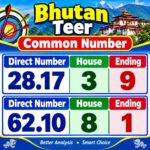
## Bhutan Teer Common Number
Another popular search term is **Bhutan Teer Common Number**.
A common-number list generally refers to numbers selected or highlighted through someone’s analysis of previous results. Different websites may use different methods for creating such lists.
Some may look at:
* Frequently appearing digits
* Recent results
* Previous-result combinations
* House numbers
* Ending numbers
* Repeated pairs
* Historical charts
Because there is no guaranteed method for predicting a future Teer result, common numbers should be regarded as an analysis-based feature rather than a confirmed prediction.
This distinction is particularly important when reading online content. A headline may describe a number as “strong,” “common” or “special,” but that language does not mean that the number is guaranteed to appear.
## Understanding House and Ending Numbers
A two-digit result can be separated into two parts.
Take the example:
**47**
The first digit, **4**, is commonly called the **House**.
The second digit, **7**, is called the **Ending**.
Therefore:
**47 = House 4 + Ending 7**
This terminology is frequently used in Teer result discussions. Some websites provide separate House and Ending charts alongside the direct two-digit result.
For a reader who is new to Teer, this terminology may seem complicated at first. In practice, it is simply a way of breaking the final two-digit result into smaller components.
## How to Check Bhutan Teer Result Online
Checking the result online is straightforward if you follow a consistent process.
### Step 1: Check the Date
First, make sure the page shows the date you are looking for. Never assume that the first number displayed is today’s result.
### Step 2: Identify the Session
If the website covers morning and night results, confirm which session you want.
### Step 3: Check F/R
Look under the First Round column.
### Step 4: Check S/R
Then look under the Second Round column.
### Step 5: Verify the Result
If the number is important, compare it with an authorised or official result source.
This is especially useful because different websites may publish information differently. A search of current online sources shows that several sites publish Bhutan-related result tables, and their displayed datasets are not always identical.
## Bhutan Teer Result Center and Result Timing
Timing is another important part of a result center.
Some online sources publish morning results around 10:30 AM and 11:30 AM, while other pages describe evening rounds at different times.
This means readers should not depend on one generic timing statement for every Bhutan Teer result.
The actual announcement may depend on the specific session and counter. If a result has not yet been declared, a responsible result center should show that it is pending rather than presenting an unverified number as final.
This is one of the most important differences between a useful result website and a misleading one.
## How to Use a Previous Result Chart Responsibly
A previous-result chart is best viewed as an information archive.
Readers can use it to:
* Find an older result
* Compare different dates
* Study the history of F/R and S/R
* Understand House and Ending terminology
* Keep personal records
* Check whether an online post matches an earlier result
What the chart should not be used for is claiming certainty about the next result.
For example, if 25 appears several times in a historical chart, that does not establish that 25 will appear again. Likewise, if 88 has not appeared for a period of time, there is no mathematical requirement for it to appear next.
The value of the chart is its historical record, not a promise about the future.
## Why Result Verification Matters
Online result pages are useful, but they should be treated as information sources rather than automatically as the final authority.
One Bhutan Teer result page explicitly advises readers to verify winning claims with the counter that issued the relevant slip.
This is a sensible approach.
Before acting on a result, check:
**Date → Session → Round → Number → Source**
If any of these details are unclear, do not assume that the number is correct.
A reliable result center should make this information easy to identify.
## Bhutan Teer Result Center FAQs
### What is Bhutan Teer Result Center?
It is an online information resource where readers can check Bhutan Teer results, previous-result charts and related information.
### What is F/R?
F/R means **First Round**.
### What is S/R?
S/R means **Second Round**.
### Where can I find previous Bhutan Teer results?
Many result websites maintain historical charts organised by date and month. Current online archives contain 2026 result entries that can be reviewed by date.
### What is a common number?
A common number is generally a number highlighted through historical or personal analysis. It is not a guaranteed future result.
### What is a House number?
The House is generally the first digit of a two-digit result. For 47, the House is 4.
### What is an Ending number?
The Ending is the final digit. For 47, the Ending is 7.
### Can previous results guarantee the next number?
No. Previous results can be studied as historical data, but they cannot guarantee a future outcome.
## Final Thoughts
A good **Bhutan Teer Result Center** should do more than simply display two numbers. It should help readers understand the date, session, First Round, Second Round and previous-result chart clearly.
For regular followers, the historical archive is particularly useful because it puts earlier results into an easy-to-read format. Common numbers, House numbers and Ending numbers can also make the historical data easier to discuss and organise.
At the same time, readers should keep a clear distinction between **results and predictions**. A result is a number that has already been declared. A common number or prediction is only an analysis or opinion about what might happen in the future.
The best way to follow Bhutan Teer information is therefore simple: check the correct date, identify the correct round, compare information when necessary and verify important results with the relevant authorised source.
A well-organised result center can make this process much easier while giving readers a clear historical record of Bhutan Teer results.